
How the Super Bowl Halftime Show Stage Is Built in Under 30 Minutes (And Why It’s a Masterclass in Event Production)
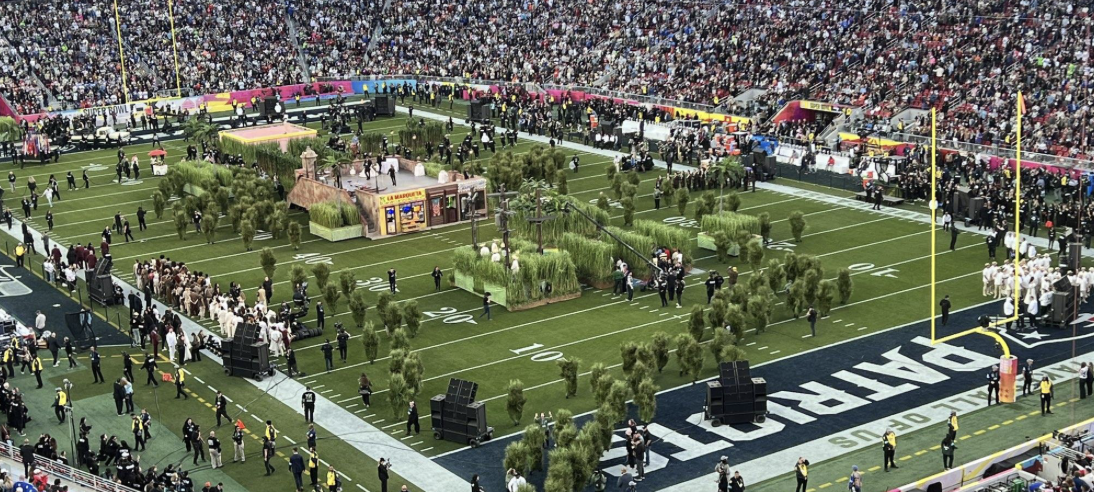
I cannot stop thinking about how absolutely unhinged the Super Bowl halftime stage logistics are.
At Super Bowl LX at Levi's Stadium, Bad Bunny’s entire show was built, performed, and struck in under 30 minutes.
Under 30 minutes. With 100+ million people watching.
As someone who plans events for a living, my brain simply cannot compute.
This isn’t just a concert. It’s a precision military operation disguised as entertainment.
Let’s talk about why.
1. The Stage Is Basically Giant Lego Pieces on Wheels
The halftime stage is not “built” from scratch.
It’s made up of pre-built rolling carts (think giant, fully wired Lego pieces)
Each unit is:
Pre-rigged with lighting
Pre-wired with audio
Pre-programmed
Locked into formation before it even hits the field
These aren’t loose elements being assembled live. They’re engineered modules that snap into place.
When halftime begins, hundreds of crew members sprint out and assemble the entire performance environment in 6–8 minutes.
Six to eight minutes!!!!!!
I don’t think I can check out at Whole Foods that fast.
2. They’re Building It on an NFL Field (That Cannot Be Touched)
And here’s where it gets truly wild.
They are building a full concert… on the actual NFL field.
The NFL is famously protective of its turf. Rightfully so. That field has to host the second half of the biggest game of the year.
So every pound of staging is calculated.
Protective flooring goes down first. Weight distribution is engineered. Wheel types are selected to avoid tearing turf. Nothing can puncture, dent, or leave an imprint.
Imagine designing a globally broadcasted spectacle, while being told you cannot scratch the carpet.
I CANNOT.
If you think convention centers are picky about their ballroom floors, try rolling truss across an NFL field. THE PRESSURE.
3. The Load-In Is a Performance in Itself
The halftime show load in is basically a military drill disguised as entertainment.
Rehearsals happen in advance using taped field layouts and separate facilities. Stage pieces are staged in stadium tunnels before the game even begins. Every crew member has a zone assignment.
There are countdown clocks. There are backup systems.
There are contingency plans for the contingency plans.
Lighting designer Al Gurdon and his team also had to design lighting powerful enough to compete with California daylight. Which means you’re not just creating moody concert vibes, you are fighting the actual sun.
Casual.
This is live event production operating at a level most people don’t even realize exists.
The Part That Gets Me
Here’s the wildest part.
We don’t even think twice.
We just expect to be entertained.
That’s how GOOD they are.
The execution is so airtight, so rehearsed, so engineered, that 100 million people sit back and say, “Cool show,” without even considering the sheer FEAT that just happened at midfield.
When something feels effortless, it usually means someone obsessed over every invisible detail.. just sayin'.
And as someone who plans events — from intimate masterminds to large scale productions — that’s the part I respect most.
Spectacle is fun.
Structure is what makes it possible.
(Also, Tribe, Inc… I don’t know how you do it, but I want to be you when I grow up. MAJOR PROPS)
I’m Ashlee. I plan events. And these are the weird things I research at 3AM.
